| OpenGL And ES Updated |
| Written by Alex Armstrong | |||
| Thursday, 09 August 2012 | |||
|
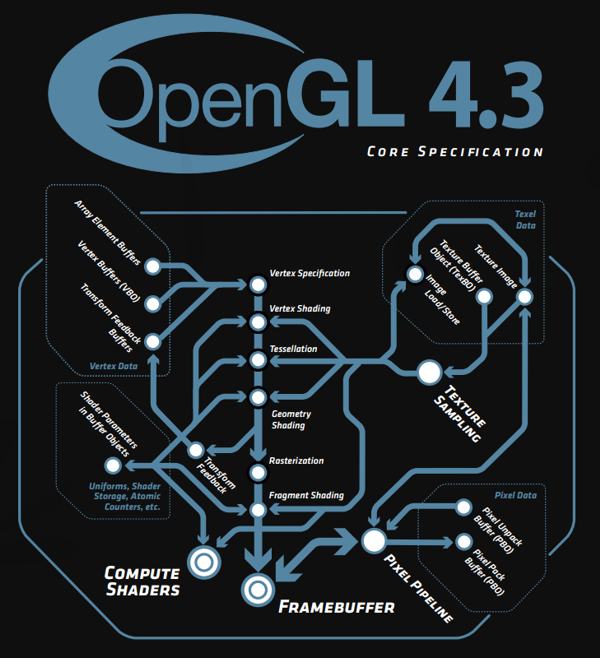
This week at SIGGRAPH 2012 the Khronos Group is celebrating 20 years of OpenGL, the cross-platform 3D graphics API specification, and has launched two updated versions, OpenGL 4.3 and OpenGL ES 3.0.
OpenGL ES is the cutdown version of OpenGL that powers 3D graphics rendering on mobile phones. It sees a major update that adds GPU support and much enhanced texture rendering speeds. By adding features from OpenGL 3.x and 4.x its shaders have been made more capable, with full support for 32-bit integer and floating point data. As a result OpenGL ES 3.0 GPUs will support more complex textures including ones with arbitrary sizes (instead of requiring the dimensions of each edge to be a power of two) and with floating point values. Also important is the addition of new compressed texture formats, ETC2 and EAC, that use algorithms devised by Ericsson and and are available royalty free.
OpenGL 4.3 is a decimal point update but it has a long list of enhancements, some of which are to keep it abreast of OpenGL ES 3.0:
Many consider that OpenGL slipped behind competing graphics packages such as DirectX, but since the Khronos group took the helm things have been moving faster. OpenGL ES still lags behind DirectX, but until Windows Phone 8 is released it will be difficult to compare the two in any realistic way. The improvements to OpenGL 4.3 are fairly minor with the exception of the compute shaders which make it much easier to use the GPU for non-graphical computations. This would allow the GPU to be used for tasks such as game physics or AI while the graphics pipeline is free to get on with rendering the next frame. Nvidia has already released a set of beta OpenGL 4.3 drivers and others are likely follow. More InformationKhronos OpenGL ES API Registry Related ArticlesOpenGL Faster Than DirectX - Or Is It? Fundamentals of Computer Graphics
Comments
or email your comment to: comments@i-programmer.info
To be informed about new articles on I Programmer, install the I Programmer Toolbar, subscribe to the RSS feed, follow us on, Twitter, Facebook, Google+ or Linkedin, or sign up for our weekly newsletter.

|
|||
| Last Updated ( Thursday, 09 August 2012 ) |