| Konrad Zuse and the First Working Computers |
| Written by Historian | ||||
Page 1 of 3 You may well never have heard of Konrad Zuse, but he has a better claim than most to be the man who invented the programmable computer in the sense of actually building one. In fact, he built several. Zuse could also be the man who invented the first high-level programming language. So why don't we know more about him and what he did?
War is usually thought to be a spur to the development of technology. Certainly the needs of the second world war pushed the development of the digital computer in the USA and in the UK. In the USA it was the need to calculate firing tables for artillery and later the atomic bomb simulations which led to Howard Aiken's Mark I and Macaulay and Eckert.s ENIAC. In the UK it was the highly secret code cracking work at Bletchley Park that needed a computer, hence Colossus. So important was the computer to the war effort you might wonder what the "other side" was doing. The answer involves the story of one man - Konrad Zuse - and a range of computers that have a strong claim to be the very first. But it's not the story that you might expect....
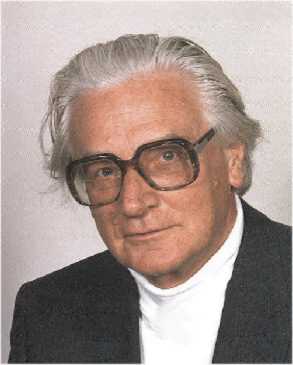
Konrad Zuse, 1910 - 1995 Konrad Zuse was born in Berlin shortly before World War I. His father, a postal administrator, and mother must have been very tolerant because they not only put up with Konrad's experiments, they actually helped fund them. From a very early age he was interested in automaton and he built a chocolate dispensing machine from the German equivalent of Meccano which even gave the right change! At the age of 18 he enrolled as a student of architecture and civil engineering at the University of Berlin, and discovered his dislike of routine calculation. At the time engineers knew how to work out problems such as whether or not a static structure such as roof would stand up, but this involved solving lots of simultaneous linear equations. The only way of doing this was the hard way, manual calculations. Solving the equations for a real structure could take months and Zuse thought that this was a terrible waste of time and very boring. His mind turned to ways of automating the calculation. You could say that he decided to invent the computer rather than do the calculations himself! In 1935 he graduated and began working at the Henschel aircraft company as a stress analyst and you can guess what that meant - more equations to solve. In 1936 he started work on his first computer having planned its design over the previous years. The date is important because it places Zuse's attempt well before the other well known attempts at building a computer. Z1 - The First ComputerKonrad announced to his parents that he was giving up his job so that he could stay at home and build a computer on the kitchen table. Not surprisingly they were "not very delighted".
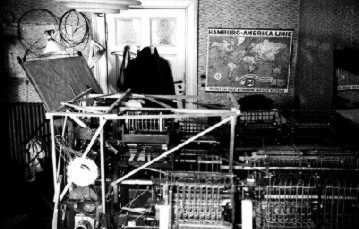
The Z1 in living room of the family home where it was built The V1, V for Versuchsmodell or "Experimental model" and later renamed as the Z1 (Zuse1) grew to be 2 meters by 1.5 meters and it was fully mechanical. It was built using yet more of the German equivalent of Meccano and consisted of one thousand thin slotted metal plates which made up its memory. Input was via a "paper" tape reader only Zuse used old 35mm film stock with holes punched in it. It also had a keyboard and showed its results via a row of lights. Although its mechanical construction was ingenious, its most important feature was that it used binary. All mechanical calculators before the Z1, and even Babagge's design, were based on decimal arithmetic. The adoption of binary made it possible for Zuse to avoid all of the complex gearing needed to do decimal arithmetic and handle the "carry" and "borrow" problem. It also led naturally to a modular design using the mechanical analog of logic gates. You might also be surprised to discover that the arithmetic unit was a 22-bit floating point unit, but it could only add and subtract - multiplication was performed by repeated addition. The machine wasn't reliable and, of course, it was very, very slow. It had nine instructions and each one took multiple cycles to complete and each cycle took one second.
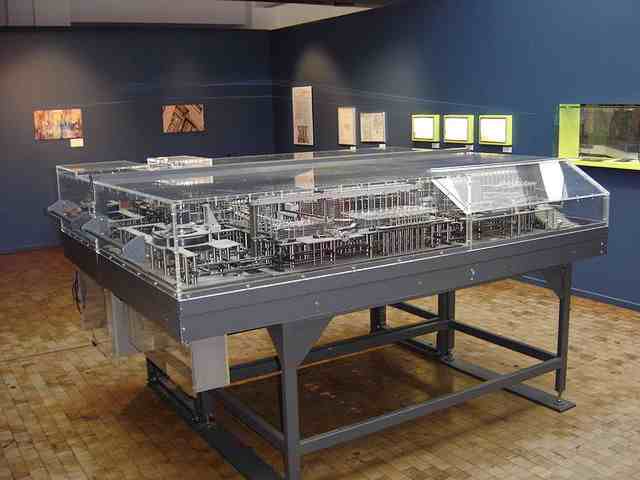
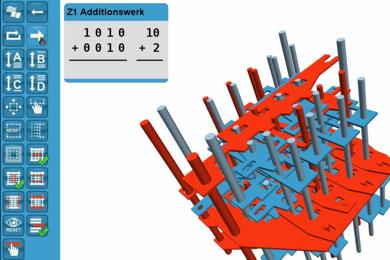
The Z1 replica in the German Museum of Technology (Berlin) Simulation of the Z1In the 1980s when he was in his 70s, Konrad Zuse embarked on a reconstruction of the Z1 which is now exhibited at the Technology Museum in Berlin. However, with 30,000 parts the reconstruction of the mechanical computer was unlikely to be robust or reliable enough for regular operation, so a team led by Professor Paul Rojas began a virtual reconstruction which has led to the construction a 3D visual simulation of the arithmetic unit for deployment on the web.
(click in image to go to simulation)
<ASIN:3540564535> <ASIN:3031398750> |
||||
| Last Updated ( Sunday, 22 June 2025 ) |