| Which Browser Holds Sway? |
| Written by Janet Swift |
| Monday, 04 March 2013 |
|
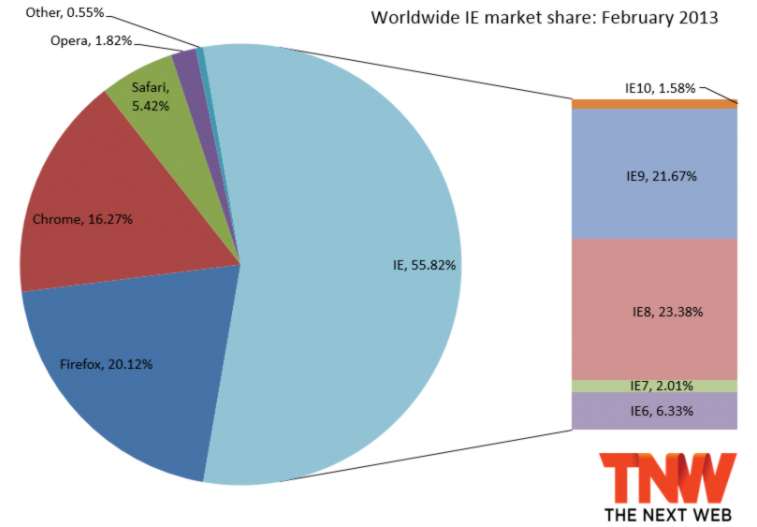
The answer to this question depends on who you ask. Latest figures for browser popularity suggest that IE comes out on top. Or that it lags well behind Chrome. How can this be? The most recent statistics for the Desktop Browser Market Share from NetMarketShare suggest that Microsoft IE still dominates in the battle for browser share.
(click to enlarge)
Additional analysis, courtesy of TNW, reveals that IE8 accounts for the largest share, followed closely by IE9 but that IE6, which Microsoft has been trying hard to eradicate for over two years, see Microsoft Steps Up Campaign to Rid World of IE6, still lingers on, accounting for over 10% of IE users.
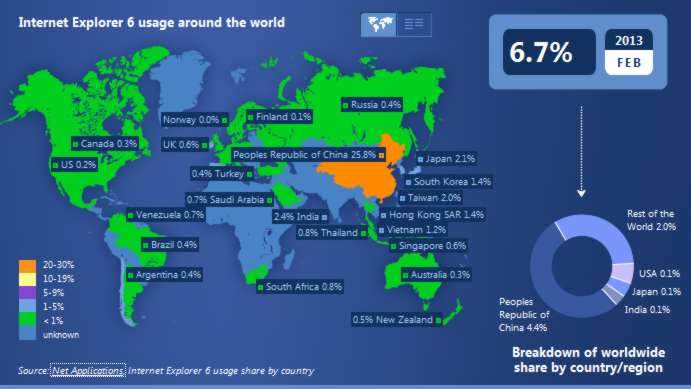
Looking at the current state of the The Internet Explorer 6 Countdown map the The Peoples Republic of China is the last stronghold of IE6 with 25.8% of users clinging to IE6. The credits reveal that Microsoft too depends on NetMarketShare for its figures.
(click to enlarge)
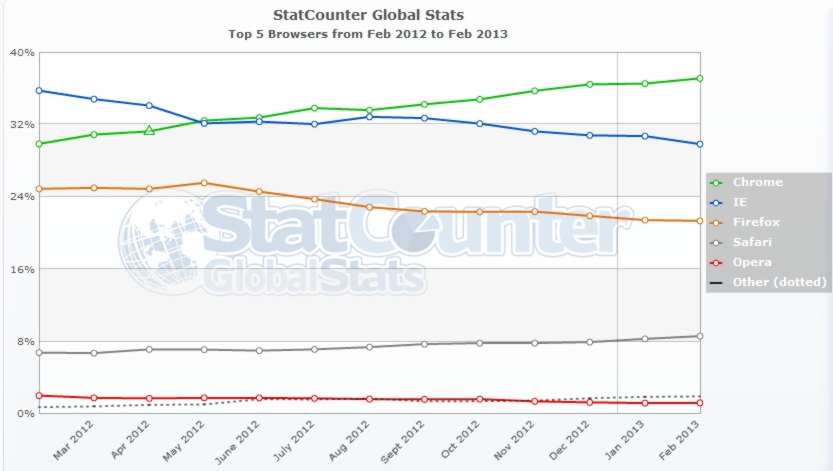
An alternative picture is pointed by StatCounter's figures. Its global statistics suggest that since overtaking IE in May 2012, Chrome has continued to forge ahead of IE:
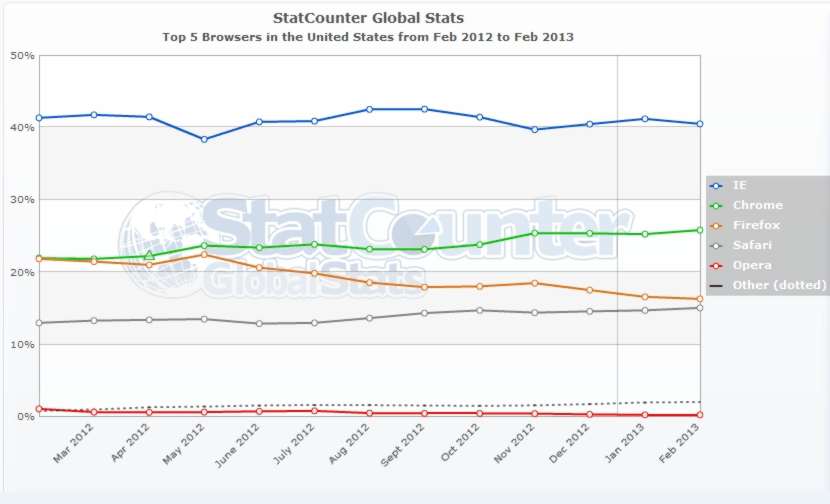
(click to enlarge) A rather different scenario is evident if you look at figures for USA, indicating that IE is still well ahead of Chrome - although with only 40% share.
(click to enlarge)
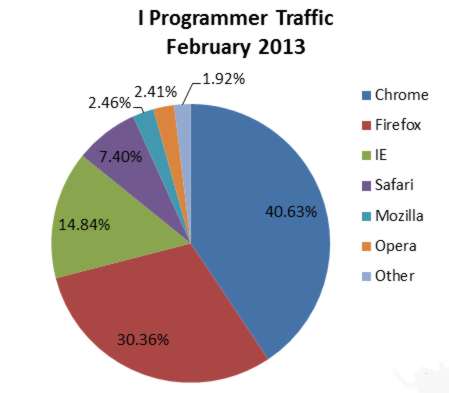
We wondered which of the scenarios was most like our own website usage. Here the breakdown for visitors to I Programmer for February 2013.
While our figures agree with Statcounter's Global ones in giving Chrome the largest share, the percentage on I Programmer is greater than 40%. Firefox has the next largest share of our vistors (30%) beating IE into a pooor third place (15%). What can account for this? Perhaps it shows that users who are savvy enough to decide for themselves which browser they install, choose Chrome or Firefox. So among intelligent well informed users, how else would you characterize an I Programmer reader, Chrome and Firefox together wipe IE out.... More InformationThe Internet Explorer 6 Countdown Related ArticlesChrome Overtakes IE In Global Stats StatCounter's Animated Map Shows Shifting Browser Landscape Microsoft Steps Up Campaign to Rid World of IE6
To be informed about new articles on I Programmer, install the I Programmer Toolbar, subscribe to the RSS feed, follow us on, Twitter, Facebook, Google+ or Linkedin, or sign up for our weekly newsletter.
Comments
or email your comment to: comments@i-programmer.info

|
| Last Updated ( Monday, 04 March 2013 ) |