| Father of Information Theory born on this day in 1916 |
| Saturday, 30 April 2011 |
|
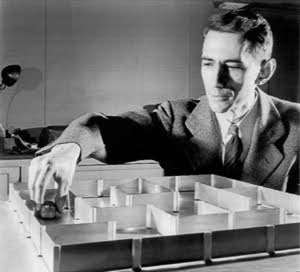
Claude Shannon who has been dubbed "Father of the Bit " for pioneering Information Theory, was born on April 30, 1916. While Shannon is quite correctly described as a mathematician, he gained his PhD from MIT in the subject, he made substantial contributions to the theory and practice of computing. He was a student of Vannevar Bush and not only worked on Bush's differential analyzer but also described it in the paper "Symbolic Analysis of Relay and Switching Circuits" in which he showed how Boolean logic could be used to indicate when a relay was on or off. Shannon's seminal paper, "A Mathematical Theory of Communication" appeared in 1948. It was published in two parts in the July and October issues of the Bell System Technical Journal. It more or less started the subject of information theory and provided much of its framework in one single act. Before the paper a "bit" corresponded to an on or off state. After the paper it was the measure of information something contained even if it wasn't a simple binary symbol. Shannon can also be considered to be the father of computer game plalying. In 1950 his paper "Programming a digital computer for playing chess" essentially invented the whole subject of computer game playing. He also felt a need to give the idea a wider audience and wrote a more approachable article called "Automatic Chess Player" for Scientific American. He even built a relay-controlled mouse, called Theseus after the legendary king of Athens who escaped the labyrinth of the Minotaur, that could run a maze and learn by storing the maze pattern as relay states.
For more about his contributions to computer history see our account of Claude Shannon. Other related articles:

|
| Last Updated ( Saturday, 30 April 2011 ) |