| Toshiba's Four-Legged Friend |
| Written by Harry Fairhead | |||
| Sunday, 25 November 2012 | |||
|
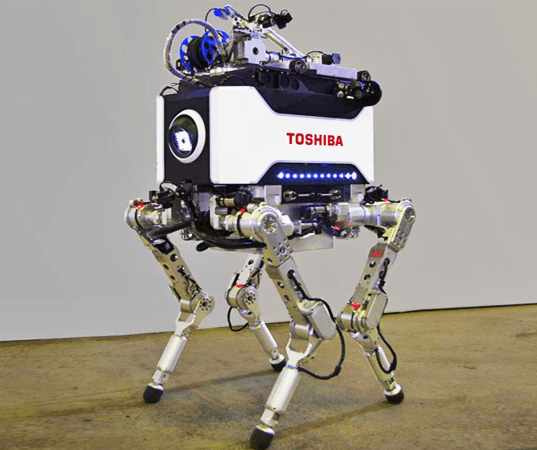
Toshiba has developed a tetrapod robot capable of investigative exploration of the tsunami-devastated Fukushima Nuclear Power Plant which are is dangerous for humans to enter. The remote-controlled robot integrates a camera to provide visual evidence of damage and a dosimeter, to measure radiation levels. The multiple joints of its legs are controlled by a dedicated movement algorithm that enables the robot to walk on uneven surfaces, avoid obstacles and climb stairs, thereby gaining access to areas that can't be reached by wheeled robots or crawlers. Weighing 65 kg (143.3 lbs) it has a walking speed of 1 km/h (0.6 mph) and a battery life of 2 hours. You can see it in action in this video uploaded to you tube by Plastic Pals:
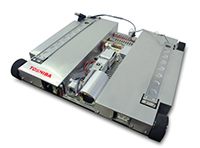
The robot also has a folding arm that can release a companion smaller robot that mounts a second camera. This can be launched from the main robot and positioned to take images of narrow places and any equipment behind them, and tubes and other places that are too small for the robot to enter. Weighing 2kg (4.4lbs) and with a battery life of 1 hour it moves at 200 meters per hour and is connected to the main robot by a cable.
Toshiba says its future research plans are to develop the capabilities and operation of the robot so as to enable it to position and install shielding, stop flows of water and remove obstacles. This isn't a challenger to Boston Dynamics' BigDog in terms of capacity or its Cheetah in terms of speed, but it is does sound as though it could play a useful role in crisis situations involving nuclear power plants, including Japan's own Fukushima disaster that still needs urgent attention.
More InformationRelated ArticlesNew Entrants to Robot Hall of Fame Bossa Nova Robotics Announces mObi
To be informed about new articles on I Programmer, install the I Programmer Toolbar, subscribe to the RSS feed, follow us on, Twitter, Facebook, Google+ or Linkedin, or sign up for our weekly newsletter.
Comments
or email your comment to: comments@i-programmer.info 
|
|||
| Last Updated ( Sunday, 25 November 2012 ) |