| A Water Droplet-Based Computer |
| Written by Harry Fairhead | |||
| Sunday, 09 September 2012 | |||
|
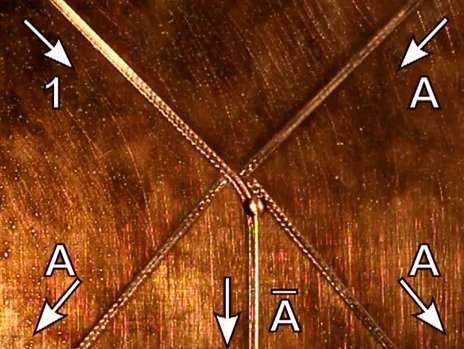
It is surprising what you can build a computer out of - crabs, slime mold and chemicals of all kinds. Now we have an example of a computer that makes use of water droplets. Fluidic computers are nothing new, but they use continuous streams of fluid - usually air or water - steered by small control jets of fluid. The latest computer to use water makes use of a different principle and the computing medium, i.e. the bits, are tiny drops of water. The idea is to take a plate of silver-plated copper and cut some grooves. The grooves are coated with a fluorine-based water repellent. The water repellent causes individual droplets to stay as spherical drops while rolling along the grooves. Each droplet represents a bit of information and logic gates can be implemented using a collision mechanism, not unlike the one used to implement the AND gate in the very strange "crab" based computer we recently covered.
Photo of NOT/FANOUT Gate
For example, in the video below you can see a combined AND/OR gate in operation:
Notice that the channel to the left outputs a bit, i.e. a drop, for each drop that enters at the top left or top right. This makes it an OR gate. The output to the right only outputs a drop when two drops enter the input channels at the same time. This makes it an AND gate. The idea, Superhydrophobic Droplet Logic, could be used to build a water drop-based computer - but why? The resulting computer would need no power and could be a good way of implementing simple logic devices. One possible more advanced application is that each water drop could carry a chemical payload. By switching the drops they could be routed to different locations and when bits were amalgamated they could produce different chemical reactions. This could be a step on the road to a chemical printer. If this seems unlikely, watch it work in the next video: >
Personally, the way that the drops move is so fascinating that I really don't think you need an application to justify the existence of a water drop computer. If you are not convinced, take a look at the video of a water drop flip-flop:
Of course the flip-flop is the basis for memory and timing systems, but it is also mesmerizing to watch. Perhaps there is a market for it as an executive toy! So the next time you say that your computer is running like treacle - it just might be. More Informationhttp://dx.doi.org/10.1002/adma.201202980 Mertaniemi H., Forchheimer R., Ikkala O., and Ras R.H.A., Rebounding droplet-droplet collisions on superhydrophobic surfaces: from the phenomenon to droplet logic, Advanced Materials (2012). Related ArticlesSlime Mold Simulates Canadian Transport System
Comments
or email your comment to: comments@i-programmer.info To be informed about new articles on I Programmer, install the I Programmer Toolbar, subscribe to the RSS feed, follow us on, Twitter, Facebook, Google+ or Linkedin, or sign up for our weekly newsletter. 
|
|||
| Last Updated ( Friday, 14 September 2012 ) |