| Computer Languages by Committee - the 1960s |
| Written by Harry Fairhead | |||||
Page 3 of 4
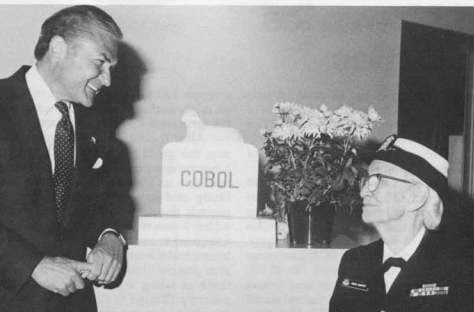
COBOLAt about the same time that the Algol committee were hard at work, the business users, well mostly people from the companies making commercial computer hardware, also formed a committee - CODASYL (Committee on DAta SYstems Languages) with a view to create a programming language for business. The first meeting was held held at the Pentagon on 28-29 May 1959. Convened under the auspices of the US Department of Defense, it was chaired by Charles A. Phillips, then Director of the Data Systems Research Staff and attended by about 40 people from three distinct groups - government (15 representatives from 7 organisations); manufacturers (15 representatives from 10 companies); potential users from a further 10 companies. Among the attendees at this meeting was Grace Hopper who is generally credited as the language's creator. The COBOL committee was very different to the Algol committee. These were practical people very concerned to produce a language that could be used - and perhaps even concerned to produce a language that could be used by programmers less talented than they. Many of them had excellent theoretical backgrounds and probably could have designed an Algol-like language if they had a mind to; but they didn't. The precursors of COBOL were FLOW-MATIC, designed by Grace Hopper's team at Remmington Rand; AIMACO, an Airforce programming language; Commercial Translator, a language specification developed but not implemented by IBM; and FACT, developed for Honeywell. The COBOL TombstoneThe report that defined the first version of COBOL (COmmon Business Oriented Language) was produced in 1960. And while this was outside the 3-month deadline originally set in May 1959 it was a laudable achievement. Trying to reach consensus about a language specification that could be used on all computers while working with a committee made up of a mix of manufacturers and users led to a good deal of frustration. Howard Bromberg, who had worked with Grace Hopper and was the corporate representative for RCA on the committee became so annoyed with the CODASYL chairman, Charles A Phillips, that he has a tombstone with the inscription COBOL sent to his office in the Pentagon. Having denied responsibility for this signal of exasperation for many years, Bromberg, he admitted it in May 1985 on the occasion of COBOL's 25th Anniversary Celebration at the Computer History Museum when many members of CODASYL gather to celebrate. The noticeable absence was that of Charles A Philips who had passed away two months previously and had donated the tombstone to the Computer History Museum.
Source: Computer Museum Report, Summer 1985 Left to right: Ron Hamm, John L. Jones, Dr Jan Prokop, Oliver Smoot, Thomas Rice, Donal Nelson, Grace Hopper , Micheal O'Conner and Howard Bromberg.
An English-like programming languageThe aim of CODASYL was to produce a language that could be read and understood by programmers and managers. They deliberately tried to make the language wordy and English-like by using lots of `noise' words that were irrelevant to the meaning. This wordiness (or should it be wordimess!) has long been the major criticism of the language. To give you some idea of how low the committee were aiming it is worth saying that they rejected the idea of using the well known signs of arithmetic i.e. + and - in favour of the verbs ADD, SUBTRACT, MULTIPLY and DIVIDE. So instead of writing
you would write
Even
would be written
At this point it looks as if I have nothing encouraging to say about COBOL but this isn't the case. The COBOL committee concentrated on the practical matters much more than the Algol committee. For example, Algol left the details of I/O undefined and up to the particular machine manufacturer to solve - an attitude that you will still find in Algol-derived languages such as C and Modula. But COBOL's greatest strength is its I/O. It introduced the idea of separating the data from the procedural part of the program. You defined the data (i.e. the record structure) that you wanted to work with in one area of the program's text and the what you wanted to do with it in another. COBOL was carefully designed to make it easy to do the sort of tasks that were involved in business data processing. It certainly didn't include any of the academic ideas to be found in Algol. The best description of it was a sort of business Fortran - but amazingly wordy compared to the compact Fortran notation. The people involved in the COBOL project were also very different from the Algol committee - they were all involved in commercial data processing, the non-glamorous but highly profitable end of computing! You could best describe the leading lights as down to earth. Grace Hopper for example was originally a mathematician who became attached to the US Navy for most of her career - so much so that rather than Dr Hopper she is generally known by her navy rank, eventually as Rear Admiral Hopper. What could be a clearer statement that she didn't think of herself as an academic! Another mathematician on the COBOL project was Jean Sammet who, like Grace Hopper, disdained the purely academic. In response to the question "Why do you think that academicians have chosen to ignore COBOL?" Jean answered "Many have a snobbish attitude and feel it is beneath their dignity".
<ASIN:0672317885> |
|||||
| Last Updated ( Saturday, 08 June 2019 ) |